Alongside that, the Musk vs. OpenAI case reached its final verdict, Anthropic's Mythos saga keeps stirring things up, and Microsoft itself published strikingly critical research on the limits of AI agents on longer tasks. An edition with plenty of movement and even more nuance. Every two weeks on the Xylos blog, we bring you a sharp and honest overview of what's really moving in the world of generative AI, with the context you need.

:focal())
The foundation remains the biweekly LinkedIn overview by Tom Van 't veld, Learning Innovator at OASE (powered by Xylos). Tom follows AI developments closely, and we translate his observations into what they concretely mean for organizations and the people working in them. Welcome to edition four.
EDITION 4 • MAY 26, 2026
Below are five stories from the past two weeks that matter most for your organization.
Google I/O 2026: new models, a rebuilt search engine, and agents that keep working for you
Google dominated AI news over the past two weeks with its annual I/O conference. On the model front, two major newcomers landed: Gemini 3.5 Flash is faster and stronger than its predecessor, with extra focus on coding tasks, and Gemini Omni is the first model to combine text, image, audio and video within one and the same system, on both the input and output side. The video version is already live in the Gemini app and YouTube Shorts; a more advanced variant for filmmakers follows later.
The biggest shift is in Google Search itself. Google itself calls it "the biggest change to the search bar in 25 years": the input field now accepts long, conversational questions like the ones you'd ask ChatGPT. On top of that, the new Information Agents search in the background on your behalf, think ticket prices or sports results. Based on your question, Search sometimes even builds small interactive mini-apps on the spot. AI Mode, incidentally, already reached a billion monthly users this year.
Google is also clearly pushing Gemini toward agent work. Gemini Spark is a personal assistant that takes tasks off your hands, such as following up on emails, updating your study schedule, or scanning your credit card statement for unnecessary subscriptions. In Gmail and Docs, a conversation mode is being added on top, letting you brainstorm out loud with your own documents and emails as context.
For organizations, this also shifts search behavior, and with it, how customers find you. Time cites research showing that 26% of users close a session entirely as soon as an AI summary appears at the top. An important signal for media companies and webshops: valuable visitor traffic is tipping. For B2B organizations, it changes the content strategy of your website, since AI models summarize what they find there. Invest in clear, authoritative content that still holds up inside a summary.
Microsoft listens to feedback, Apple takes the multi-model route
Microsoft is adjusting Copilot based on user feedback. The floating Copilot button in Word, Excel and PowerPoint could cover formatting options or cells in certain scenarios. Microsoft is now rolling out a fix that lets you hide the button or dock it back into the Ribbon. In Edge, the separate Copilot mode is being folded into the browser itself, simplifying the user experience. For organizations guiding their employees in working with Copilot, these UX tweaks lower the friction in practice.
At Apple, the strategy is visibly broadening. iOS 27 will build in Claude and Gemini alongside ChatGPT as alternatives within Apple Intelligence. A new menu lets you choose which assistant Siri hands a question off to. Apple is also working on a screenless AI pin that leans smartly on the existing ecosystem: audio through the AirPods, visuals on the Watch, and heavy computation on the iPhone. A design with a much better shot at success than the failed Humane Pin.
The common thread: end users are once again getting more control over which model does what. For IT leaders, that brings both opportunities and headaches. The choice of which model runs which use case becomes more important, and agreements on data, governance and compliance need to evolve alongside it. Anyone who lays the groundwork today with clear guidelines and a well-thought-out model mix avoids the later sprawl of uncontrolled AI choices within the organization.
Agent sprawl and the silent errors of AI agents
On the work floor, AI assistants are shifting from pilot to daily reality, and that reality turns out messier than the marketing brochures suggest. The Wall Street Journal documents a new phenomenon called 'agent sprawl': everyone in an organization builds their own little AI helper, and some companies are now paying more for AI usage than for the employees the agents were meant to lighten the load for.
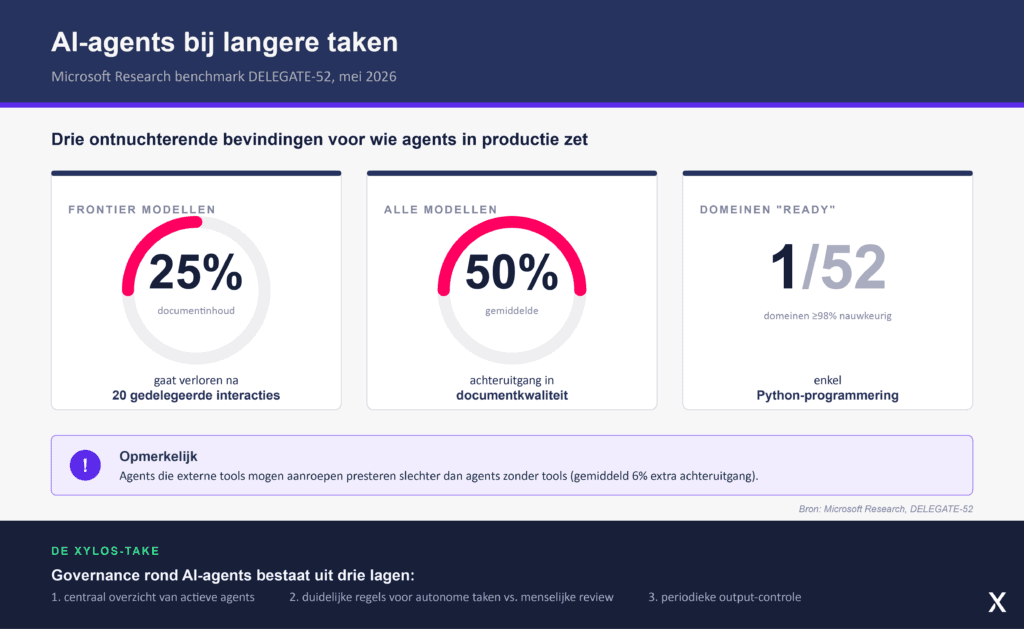
Microsoft itself adds a sobering piece of research to that. On longer tasks, current AI models make rare but serious errors that corrupt documents unnoticed. Notably, agents allowed to call external tools perform worse than agents that can't. That reinforces the importance of a structured approach to AI coding tools. We wrote earlier about vibe engineering as a framework for keeping these risks manageable.
For Belgian organizations, governance around AI agents is now truly moving to the forefront. A workable framework has three layers: a central overview of which agents are running in your organization, clear rules about which tasks an agent may carry out independently versus with human review, and a recurring review cadence where you periodically check the output of longer tasks. Without that structure, the productivity gain disappears again into fixing silent errors.
Cybersecurity: AI attacks, AI defends, and bug bounties still exist
The security story around Anthropic's Mythos keeps cracking under its own hype. The lead maintainer of curl, a widely used internet tool, tested the model and got five reported vulnerabilities, of which only one actually held up. At the same time, Anthropic positions Mythos as the future of AI cybersecurity, while the company itself launches a classic bug bounty program in which human researchers report vulnerabilities in its products.
On the other side of the battlefield, Google's security team for the first time intercepted an attack written with AI's help: a script that bypasses two-factor authentication on a popular admin tool. The AI origin gave itself away partly through the extensive in-code explanations and a self-fabricated severity score. OpenAI, meanwhile, responds with a more widely available cybersecurity version of GPT-5.5.
The message for anyone responsible for IT security: the cat-and-mouse game between attackers and defenders is moving into a new phase. AI-generated attacks are becoming more common, and your organization's detection capacity needs to evolve alongside them. A well-thought-out mix of technology, awareness and trained expertise still makes the difference between an alert caught in time and an incident that stays under the radar for days.
Trust in AI content takes a hit, AI literacy becomes more urgent
The pace at which AI output is flooding the internet is accelerating the debate about reliability. Consulting firm EY had to retract one of its own reports after 16 of the 27 cited sources turned out to be fabricated or incorrect. Dutch webshops Bol and Standaard Boekhandel were caught selling hundreds of AI-generated books without clear labeling. And researchers warn of a form of AI cannibalism in which models trained on the output of other AIs gradually degrade. Tom predicted that phenomenon more than a year ago.
At the same time, the counter-movement is growing. American students are starting to massively boo speakers who glorify AI, while top executives at AI companies publicly express surprise at the persistent backlash. The gap between enthusiasts and critics is widening.
For organizations, that comes with a dual task. On the input side, it calls for tight agreements on which sources you trust for which decisions, how you double-check AI output, and when human review is mandatory. On the competency side, AI literacy becomes a baseline skill at every level of the organization. Training that teaches employees to prompt, evaluate and read critically remains an important link in any serious AI approach. That's exactly where it overlaps with what Tom and his colleagues at OASE and Xylos Learning build every day: AI literacy that scales alongside the tooling you bring in.
We'll be back in two weeks with the next edition.
About Tom Van 't veld
Tom has worked for Xylos for years, where he started as a Microsoft Office trainer and grew into the driving force behind innovative learning concepts. He is at the origin of OASE, Xylos's online learning platform, and developed, among other things, the Digital Coach concept, a Microsoft Teams Escape Room app, and the mAindset game that helps employees learn to prompt with AI in a playful way. As Learning Innovator, his focus in recent years has increasingly turned to what AI means for the way we learn and work. Want to react or keep the conversation going? Find him on LinkedIn.