
Gradient blur
Vibe engineering: de mindset achter elke schaalbare AI-aanpak
Blog
Artificial Intelligence
Data & Analytics
Back to overview

Vibe engineering: the mindset behind every scalable AI approach

Everyone's talking about vibe coding. The real shift runs deeper, and it determines the difference between more productivity and more risk.
07 - 05 - 2026

A developer proudly shows me his latest creation. In three weeks, he built an AI agent that merges reports from four internal systems. The demo works flawlessly. Management is impressed. Three months later, the same agent is in production and a ticket escalates: the numbers in the weekly board meeting no longer add up. Nobody can reproduce where the agent gets its data from. The developer explains, honestly: "I had Copilot generate that whole part. It worked, so I left it as is."

A story like this is rarely about a bad engineer. It's about an industry that's changing at breakneck speed, and about how you respond to that as an organization.

This is the fifth article in our series on data and AI. In the previous parts, we looked at AI sprawl in organizations, the Power Platform as a bridge to controlled AI integration, the data foundation with Microsoft Fabric and grounded AI as an architectural approach. Each time, technology was the focus. This time, we look at the people who work with it. Because without the right mindset, every technical investment stays an experiment that will eventually derail.

The vibe-coded agent from our first article isn't just a footnote. It's symptomatic of a fundamental shift in how software gets built today, and how it needs to be maintained tomorrow.
How vibe coding emerged

Earlier this year, Andrej Karpathy, former head of AI at Tesla and one of the most influential voices in deep learning, introduced a term that split the software world into two camps: vibe coding.

His description was as simple as it was provocative. You surrender to AI, describe what you want to build, accept what it generates without fully understanding it, and keep pushing until it works. "I'm just vibing," he wrote. The code belongs to AI. You steer the intent. The reactions were predictable: enthusiasm on one side, horror on the other. Both reactions miss the actual question this way of working poses to anyone who builds software, deploys AI, or makes technology decisions for an organization.

The right question goes deeper than the debate over whether you're allowed to accept code you don't fully understand. The right question is what's fundamentally changing in the engineer's role, and how you build on that as an organization. Vibe coding is here. The question is how you deal with it.

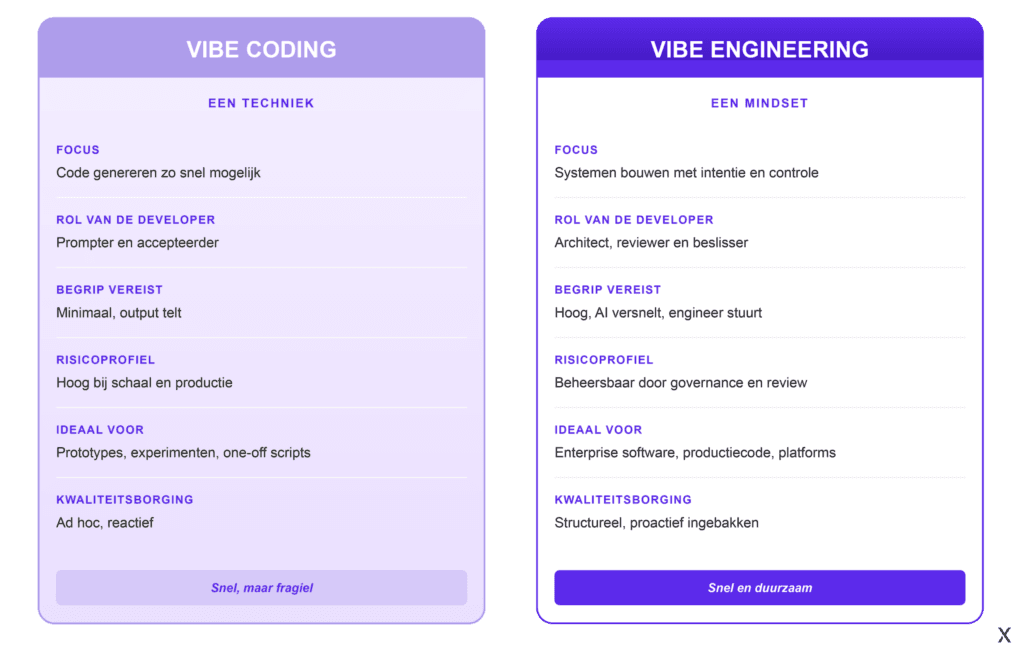
Vibe coding is a technique. Vibe engineering is a mindset. It determines the difference between more productivity and more risk.

What vibe coding is and isn't

Vibe coding is the practice where a developer uses AI tools like GitHub Copilot, Cursor, Claude or ChatGPT to generate code based on intent rather than implementation. You describe the desired behavior in natural language. AI writes the code. You review, test, adjust and repeat.

In its most radical form, as Karpathy described it, you accept the output without diving deep into the logic. You trust the system rather than your own understanding of it. That works surprisingly well for prototypes and for situations where speed matters more than robustness.

That's exactly where the criticism holds up. Code you don't understand, you can't debug. Code you don't understand, you can't secure. Code you don't understand, you can't scale to a production environment that serves thousands of users and has compliance requirements.

Vibe coding is a powerful tool. A tool without craftsmanship is dangerous.

Vibe coding versus vibe engineering: the real distinction

The difference is fundamental. Vibe coding is a technique that lets individual developers produce faster. Vibe engineering is the discipline that ensures that speed delivers value instead of technical debt.

Where vibe coding focuses on the output of an individual task, vibe engineering looks at the system as a whole. Where vibe coding accepts that code works without understanding, vibe engineering requires that the architectural decisions are well-founded. Where vibe coding treats AI as a source, vibe engineering treats AI as a colleague sitting at the table, with strengths and weaknesses.

Vibe engineering builds on vibe coding. It's the mature version of it. It embraces the productivity gains that AI-assisted development offers and places those gains within a framework of craftsmanship, architectural thinking and organizational responsibility.

The vibe engineer uses AI the way an experienced surgeon uses a scalpel: as an extension of expertise.

The five pillars of vibe engineering

What makes someone a vibe engineer rather than a vibe coder? It comes down to five shifts in thinking, working method and sense of responsibility.

→ The result: engineers who deliver faster and write better code, thanks to a thoughtful collaboration with AI.

Why this matters for your organization

This story isn't only relevant for developers. It touches everyone who makes decisions today about how software gets built in their organization.

An organization that embraces vibe coding without cultivating vibe engineering sees impressive productivity gains for the first three months. Then the problems start. Code nobody understands. Security holes that no review caught. Systems that can't be maintained. It's the same sprawl we described in the first article of this series, just one layer deeper, in the codebase itself.

Vibe engineering prevents that scenario. It makes AI's productivity gains sustainable because engineers use AI as an extension rather than as an outsourcing partner. An assistant that codes with them, rather than in their place.

For IT leaders: redefine what you expect from engineers
The developer of tomorrow has less value as a typist and more value as an architectural thinker, critical reviewer and AI collaborator. Adjust your hiring, your training and your evaluation criteria accordingly. Today.

For the C-suite: understand the productivity paradox
AI increases output speed, but without vibe engineering it also increases your risks. Organizations that invest now in the right ways of working around AI-assisted development will be the frontrunners in two years. Those who don't will later pay a hefty bill in the form of technical debt, security incidents and rework.

For developers: this is your moment
The engineers who learn today how to make optimal use of AI as reviewers, architects and prompt engineers will become the most valuable professionals of the next ten years. The bar is higher than ever. Those who grow with it will find opportunities that didn't exist before.

The question is no longer whether your engineers are going to use AI. That question has already been answered. The real question is how they do it: in a way that delivers value or one that increases risk.

The broader implication: a higher level of abstraction

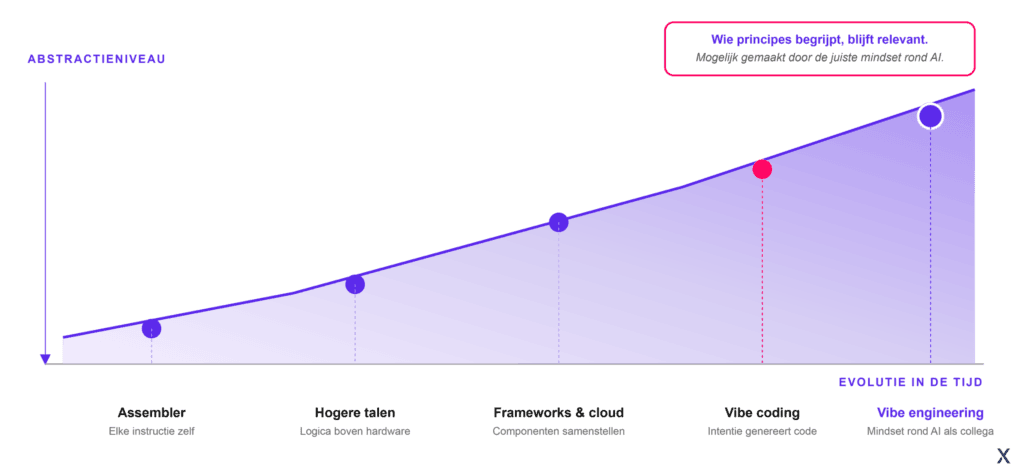
Vibe engineering is symptomatic of a broader shift we see across the entire industry: the abstraction layer is rising. Just as we once stopped writing assembler and moved to higher-level programming languages, we're now stopping writing every line ourselves and starting to operate at a higher level of abstraction.

Craftsmanship isn't disappearing here. It's evolving. The best engineers of the next generation will be judged on the quality of the systems they build, regardless of which tools they use to build them. The number of lines of code they personally write matters less and less.

That abstraction layer does require something new, though: a deeper understanding of why systems work, on top of knowing how they work. When you delegate implementation to AI, you can only make sound architectural choices if you understand the underlying principles.

That's what we at Xylos mean by vibe engineering. For us, it's about a way of working that makes full use of what AI can do, with human expertise remaining the irreplaceable anchor. The hype around it is secondary.

Xylos helps your engineers evolve toward the vibe engineering mindset

The shift to AI-assisted building is more than a tooling question. It touches culture and skills. At Xylos, we guide organizations through that transition: we help select the right AI development tools like GitHub Copilot and Azure AI, set up review and governance processes, and upskill engineers in the new core skills of the profession. Want to know where your organization stands today? Get in touch for a no-obligation conversation.

Are you already using AI in your development workflow, as a vibe coder, a vibe engineer, or somewhere in between? I'm curious how you draw the line.

About the author

[Peter Verrykt ](https://be.linkedin.com/in/peter-verrykt)is Business Unit Lead Data & AI at Xylos and guides organizations in turning data into concrete business value. He helps companies look beyond technical implementations and deploys data and AI as a foundation for better decisions, greater agility and sustainable growth.