That sharpens the question around AI: how do you keep things manageable when systems start making and executing decisions on their own? Our Partner Alliance Manager Frank Dierckx is in Las Vegas this week for HPE Discover 2026, where the agentic enterprise takes center stage. In this third part of his series, he shares his reflections after the keynote by Fidelma Russo, CTO and head of Hybrid Cloud at HPE.

:focal())
We're on day three of HPE Discover and the tone is shifting. The first days were mostly about the foundation: network, data and compute. Today, Fidelma Russo delivered a keynote with a clear message for me. The question is no longer whether AI changes your organization, but how you keep it under control and get it running operationally.
For those who don't know Russo: she is Chief Technology Officer at HPE and heads the Hybrid Cloud division. With more than thirty years of experience in the industry, previously at names like EMC and Sun Microsystems, she looks at AI with the eye of a builder. That makes her story concrete. She looks past the hype and focuses on the question of how to actually make it all run.
In my previous two posts I wrote about the foundation and about the network as the platform. This third part brings it all together where it ultimately matters: in your operations.
Workflows give way to systems that act on their own
We're clearly in a next phase. AI is no longer a standalone assistant that helps here and there. It's evolving into what HPE calls a “distributed agentic enterprise.” Behind that term is a simple idea: intelligence lives everywhere, in your applications, your workflows, your teams and your infrastructure, and it starts making decisions and executing actions on its own.
The shift that stuck with me most is about how the work happens. In the past, a human decided and the system executed. Now systems are emerging that observe, reason and act on their own. That happens through AI agents working together. And that's exactly where the challenge lies, because that intelligence isn't centralized. It's spread across silos, data and platforms.
Today the difficulty lies in something other than building AI. It's about orchestrating, governing and running it reliably.
Closed-loop operations: AI in a controlled circle
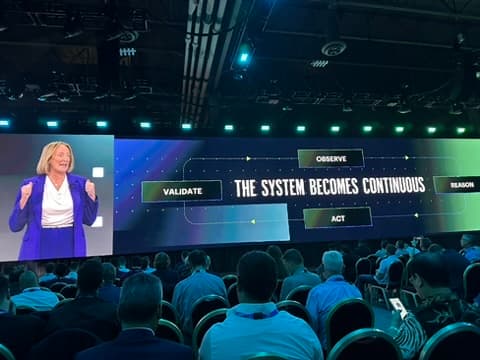
HPE's answer to that is called closed-loop operations. Systems observe, analyze, take action and check whether the result is correct. And they do so continuously, in real time.
That only works if three foundations are in place: reliable data, efficient infrastructure and intelligent operations. Each of them came back in the keynote.
Data becomes an ongoing building block
What struck me: data is no longer seen as the input for a model. It's a component that keeps running through the entire process. HPE wants to make that concrete with HPE Data Fabric 8.2. Data becomes available everywhere, whether you're working at the edge, in the cloud or in your data center. Governance and security are built in by default, and identity and access are handled automatically.
The insight behind it is simple. Without reliable, accessible data you'll never build AI that truly scales.
Token economics: AI costs money, a lot of it
One of the most concrete parts covered token economics. Every AI agent consumes tokens, reasons continuously and executes actions. As a result, inference is no longer a one-off workload, but a constant cost that keeps ticking.
One number stuck with me: examples of 13,000 dollars per agent per month. That immediately puts things in perspective. AI economics thus becomes infrastructure economics. Success depends on efficiency, scale and consumption, and not just on the model itself.
HPE illustrated this with an internal example, a platform codenamed Mindstone. They built it on-prem, with private cloud AI. The result is an environment that runs roughly thirty times cheaper and saves almost 100,000 dollars a month. The lesson is clear. Whoever controls their data and their infrastructure wins on cost and on governance at the same time.
Storage becomes memory
Something else that stood out to me: storage is evolving into active memory. With the HPE Alletra Storage X10000, featuring KV cache acceleration and an NVIDIA certification, time to first token becomes up to twenty times faster and throughput is seventeen times higher.
Why does that matter? Without that memory, agents have to rebuild their context every single time. That's pure waste of compute, with rising costs as a result. It's exactly the kind of detail that has a massive impact at scale.
Infrastructure grows along, it doesn't shrink
Some people think AI shrinks your infrastructure. In practice, the opposite happens. More agents means more API calls, more database queries and more load on your GPUs and CPUs. AI creates a multiplier effect across your entire IT landscape.
That's why HPE positions its private cloud portfolio, with the PC1000, 3000 and 7000, together with Private Cloud AI, as the foundation to keep that manageable.
Intelligence in your operations
This is where it hit closest to home for me personally. Through its software stack, HPE brings AI directly into operations. Morpheus handles orchestration and automation, OpsRamp handles observability and Zerto handles resilience.
The real core lies in GreenLake Intelligence. That's where central governance for agents comes together, with identity and policy management and orchestration via a “planning agent.” On top of that there are copilots for compute, orchestration and observability. In practice, that means you manage, automate and troubleshoot your infrastructure with natural language and AI support.
What I found interesting was the link with ServiceNow. That integration creates the bridge to an autonomous AI workforce. So you don't just get insights, you also get automatic service delivery.
A reality check from customers
What I appreciated were the customer testimonials. AMD sees AI infrastructure as an opportunity to evolve from token consumer to token generator. Point32 Health emphasizes governance, reusable AI platforms and AI skills within the organization. Both confirm the same thing. AI is just as much about organization and processes as it is about technology.
What I'm taking away
If I sum up day three from my own point of view, it comes down to five things:
AI has become an operating model, no longer a project.
Token economics is becoming a decisive factor in every business case.
Data governance is growing into a basic requirement.
Your infrastructure is becoming more critical and more complex at the same time.
And above all: you need to govern AI, not just build it.
The real shift lies in the way you give AI a place. It's less about adding AI to what you already do, and much more about weaving AI into how your organization works. That's a bigger exercise than a new use case, and it determines whether all those use cases ever deliver value.
I'm curious how you see this. Is your challenge mainly about building AI applications, or are you also finding that governing them is becoming the real question?
Also read [part 1 on the foundation](/inzichten/de-echte-uitdaging-van-ai-je-fundament) and [part 2 on the network](/inzichten/netwerk-voor-ai).
About the author
Frank Dierckx is Partner Alliance Manager at Xylos and follows the evolution of infrastructure, partner ecosystems and emerging technologies. His expertise helps customers make technology choices that are technically sound and economically responsible.