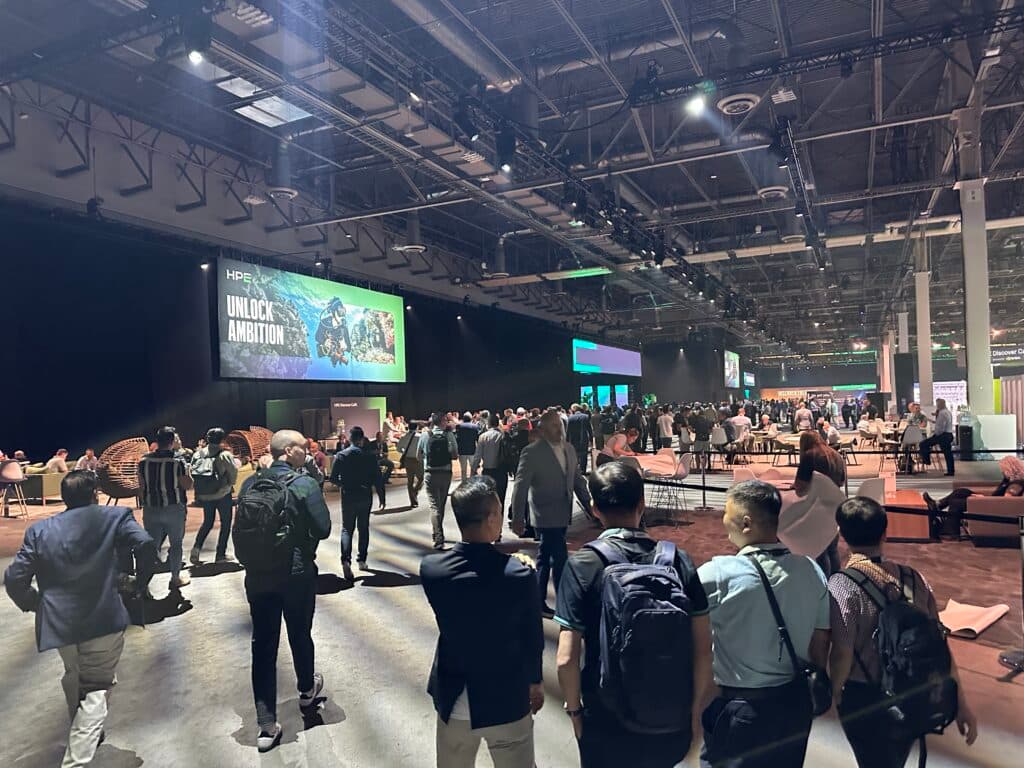
The real question is whether the foundation is ready to carry it. Our Partner Alliance Manager Frank Dierckx is in Las Vegas this week for HPE Discover 2026, which opened for partners with the HPE Partner Growth Summit. He shares his reflections after the keynote by CEO Antonio Neri.

:focal())
This week, HPE's customers and partners are gathering in Las Vegas for HPE Discover 2026, the flagship event around networking, cloud and AI. For partners, the week kicked off on Monday with the Partner Growth Summit. CEO Antonio Neri's keynote carried a telling title: building for AI starts with your network.
Over the past few months, it's felt like every customer conversation revolves around the same thing. New models, new use cases, an endless stream of demos. But the more I'm immersed in it, the clearer it becomes that AI itself is rarely the real problem. The challenge is almost always somewhere else.
Beyond the experiment
Many organizations are past the initial hype today. Most have run a POC, built a chatbot, or tested a first GenAI case. But as soon as you want to take that next step toward production, things start to strain.
Questions suddenly pop up. How do you get your data in order? How do you keep this affordable? What about security and governance? And how do you scale this without rebuilding everything? You automatically end up at something that sounds less sexy than AI itself: architecture.
Back to basics, but differently
What strikes me, including in HPE's vision, is that the conversation keeps returning to the fundamentals. Simply because there's no other way.
The network takes on a central role again. We spent years investing in applications and cloud, but with AI that network becomes critical again. Data has to move faster, more securely and more consistently between edge and data centre, in both directions. If you want to run AI at scale, your network has to handle it. No bottlenecks, no surprises. You notice the difference straight away: AI that stays fast and affordable, even as usage grows.
Hybrid is the reality, no longer a choice. In theory, everything in the cloud still sounds appealing. In practice I see few customers who are really there. Data stays spread out. So do workloads. And AI simply comes on top of that. The question is no longer where your workloads run, but how you keep the whole thing manageable. That is where I see the real value of a platform like GreenLake: it brings the complexity back under control. The result is an environment you control, instead of one that chases you.
Data remains the limiting factor. Everyone wants AI. But far from everyone has data that is ready for AI. That is probably the biggest difference between a nice demo and a working solution. Access to the right data, in the right context, with the right governance. Get that in order and AI becomes reliable enough to really build on.
Security suddenly becomes a lot more concrete. As long as AI only suggests, the way a copilot does, it stays manageable. But as soon as systems start taking actions themselves, the game changes. We are moving towards AI agents that make decisions and carry out processes on their own. That is powerful and risky at the same time. Security then becomes something that sits in the architecture from day one, not a finishing touch afterwards. That is how you stay in control when systems start acting for themselves, instead of having to step in after the fact.
AI agents: fascinating and confronting at the same time
What I personally find most fascinating is the shift toward agentic AI. These systems no longer just support, they act on their own. They reason, make decisions, and carry out actions. A kind of digital workforce.
That sounds impressive, and it is. But at the same time, it exposes how unready many organizations still are for it. Because if an AI agent makes a wrong decision, who's responsible? And how do you intervene?
What does this mean for Xylos as a partner, and for you?
In my role, I notice this fundamentally changes the conversation. It's less about which AI use case we can build, and much more about whether the client is ready to actually make AI land.
That means thinking along about architecture, making choices around platforms, putting governance on the table, and setting realistic expectations. And perhaps most importantly: daring to say that AI isn't always the first step.
For you as an organization, it comes down to the same shift. The question isn't which AI application you build first, but whether your foundation is ready to carry one. Anyone who looks at that honestly avoids costly detours and puts AI to work where it actually pays off.
Conclusion: less hype, more foundation
AI undoubtedly remains a gamechanger. The real impact lies in what it forces: organizations need to get their foundations in order. Network, data, compute and security. The basics, but at a level we never needed before.
Organizations that have that foundation in order move to production faster and keep their costs under control. They can also deploy agentic AI with confidence, where others stay stuck at nice demos. It's less visible work than a new AI case, but it determines whether that case ever delivers value. That's where the real work lies for me, and where we as a partner can make the difference.
I'm curious how you experience this with clients or internally. Do you mostly run into use-case challenges, or more into the underlying architecture?
This is part 1 of my series on HPE Discover 2026. Also read [part 2: The network for AI, taking Rami Rahim's keynote as its starting point](/inzichten/netwerk-voor-ai).
About the author
Frank Dierckx is Partner Alliance Manager at Xylos and follows the evolution of infrastructure, partner ecosystems and emerging technologies. His expertise helps clients make technology choices that are technically sound and economically justified.